If your voice students are STILL flipping, straining, or losing power when they sing, the industry has let you down.

With a lifetime of experience (like… singing since you were four) and a genuine love for helping singers (you don’t do this for a penthouse in Hollywood)… you deserve better.

You shouldn’t be left scrambling when your student gets stuck. You shouldn’t be three lessons in, watching them look down in frustration, while your stomach sinks because you still don’t have a clear path forward.

The truth is, it’s not you. It’s an industry that’s flooded you with scattered tools and half-finished methods, but never given you a practical, reliable system you can trust.

That gap stops here.

Because there is a consistent, proven way to help students sing smoothly from low to high, without flips or cracks…

To hit high notes without strain…

And to keep their sound strong, beautiful, and powerful from start to finish.

Put that in your hands, and you’ll be amazed by how quickly things turn around.

Just a few weeks from now, you could be watching your student nail that high note so clean it nearly knocks you off the piano bench…

Your inbox packed with “Can we squeeze in another lesson?” emails…

And your feet finally up at the end of the day because everything’s working exactly like it should.

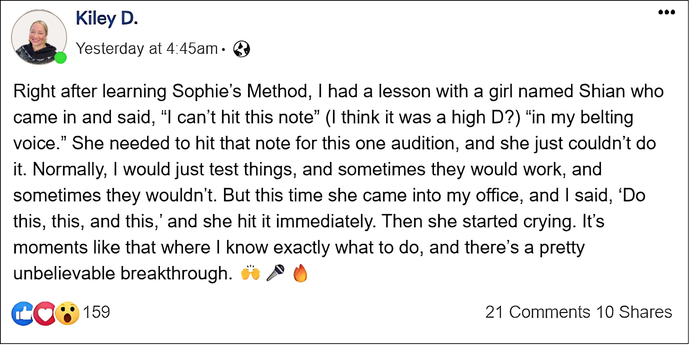
Kiley’s student instantly hit the high note she’d been struggling with — and had an emotional breakthrough that left them both speechless!

Before we get into that, let me introduce myself. 

Hey! Sophie Jolls here.

When I’m not binge-watching The Office with my husband, chasing my kids through the creek, or serenading our Goldendoodle Dakota (who usually just stares at me like I’ve lost my mind 😆)…

I’m doing something I love just as much:

Helping voice teachers master the art of teaching mix voice.

After nearly two decades of teaching, spending thousands on training, and learning a lot the hard way, I noticed something:

Most of us were left with confusing theories, intimidating science, and a million different methods for teaching voice.

So, it’s no surprise that sometimes, instead of building up your student’s voice, you find yourself… stuck.

In my experience, there's nothing more anxiety-inducing for a vocal coach (or any teacher, really) than that moment you realize you don't have the answer your student needs and you have no idea how to find it.

That kind of moment can make you feel like a total fraud.

For me? In those moments, I’ve felt like I was letting my students down.

And here’s the thing…

You deserve tools that help you handle any challenge that comes your way (whether you’re working with a beginner or advanced singer, a male or female student, or someone young or older).

You deserve to understand the root of the problem and have what you need to guide them through it.

You deserve to experience the thrill of those “ah-ha” moments when your student finally gets it and their whole face lights up.

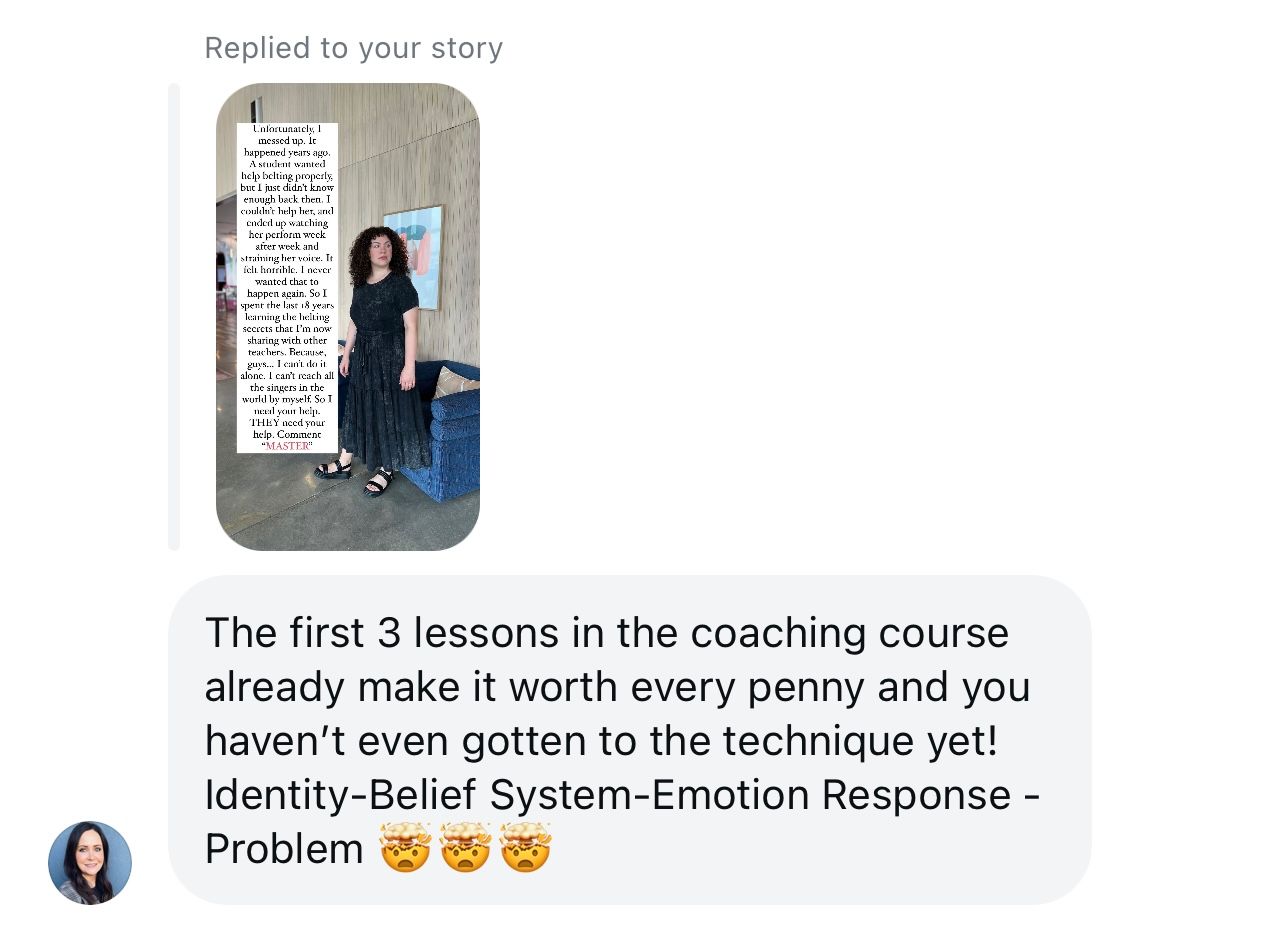
Ellie went from confusion to confidence when she applied each lesson with clarity and purpose.

6 Reasons Why You Don't Have the Answers Your Students Need

(and how to fill the gaps the industry left)

REASON #1:

#1: You might be missing the root cause of your student’s flipping, breaking, cracking, straining, or losing power.

You’ve tried vocal sirens, lip trills, vowel modifications, more breath support, less breath support…

You’re hopping from tool to tool, hoping something will click for your student.

But if you don’t understand why it’s happening in the first place, none of them will work consistently. 

For those pivotal points, there is only one thing that does the trick.

Here’s what you need:

You need to find the bridge between the registers, or what I call “the staircase,” and help your students strengthen it. Once you have “the staircase,” you can develop the mix voice. 

And when you have a proven, reliable way to teach your student to access their mix, they can control their belt, volume, dynamics, and even pitch.

REASON #2:

#2: You can’t get a straight answer on what mix voice really is (and how to get it to work every time for any student)

Let me guess…

You’ve been told:

Mix is a placement.

Mix is a resonance balance.

Mix is a vocal register.

Mix is NOT a vocal register.

Mix is everything and nothing at the same time.

So you nod along, then leave wondering… but what do I actually DO?

Is it a register? A placement? A vowel thing? A breath thing?

You might gain a pretty good understanding of your own mix (if you’re lucky).

But when you try to help your students with it, it doesn’t click. 

To build mix, your student needs a strong foundation in both chest and head voice.

And you need to know exactly where their voice is right now so you can train the underdeveloped side.

The industry has failed to teach this skill.

And without it, most teachers jump straight to exercises, which is exactly why their students are struggling.

You need a clear diagnostic:

• Know the students’ voice type

Build the underdeveloped side first

• Then, connect the chest and head voice using targeted exercises that build “the staircase.”

REASON #3:

#3: Feeling like an impostor is your MO

If you’ve ever left a lesson drained and second-guessing yourself…

Feeling like you’re giving your students generic answers…

Or you’ve hesitated to teach specific techniques and/or take on certain students…

Then, impostor syndrome is holding you back… (that dirty little gremlin)

How do you stop him?

You need a clear and practical method that works consistently across all students. 

Once you have that, lessons shift from…

Am I playing the scales right?

Am I telling them the right thing?

To “Ah, I see. Here’s what we need to do.

REASON #4:

#4: If it’s not working, you try harder, give it time, or start turning your students into guinea pigs

“Okay, let’s just do it again.”

“Let’s revisit that other exercise.”

“How about we just give it more time…”

But nothing is working, so you reach into your grab bag of vocal exercises and pull out another shot in the dark.

Repetition isn’t the problem.

What you need is:

Precision.

You need a way to determine your students’ voice type and identify the exercises that will work best for them based on that assessment.

Once you know what to listen for and how to respond, you unlock a new range of confidence for both you and your student.

REASON #5:

#5: You can hear the problem, but what do you do next?

You hear the break. The strain. The disconnect.

Your ears are right. You can hear the problem.

But how do you fix it?

Having a clear understanding of mix voice, for one…

But here’s the deeper layer no one talks about:

75% of vocal problems aren’t technical.

There are 3 layers to your student’s vocal blocks, and if you’re not trained to identify those root causes, you’ll apply the correct technical fix to the wrong problem.

Here’s what you need:

A reliable method to follow so you know which layer the problem is originating from and what tools to use to coach your student through it.

REASON #6:

#6: You think you’re stuck, but really, it’s your student.

You’re doing everything you can to help your students.

You’re showing up prepared, giving thoughtful cues, assigning the right exercises…

But sometimes, it’s not that you’re missing something.

Sometimes, it’s your student who isn’t ready to grasp what you’re showing them.

What you need:

A method for helping your students shift their beliefs, not just their technique.

And when you know how to coach through those belief shifts, your technique finally falls into place. Your students stay committed. And their progress sticks.

So…

If you still think it’s normal not to have clarity on your students’ biggest vocal struggles, then I’ve missed the mark in writing this.

You’re meant to have the right answers for your students.

And when you don’t, you should have the tools to find them, right there in the lesson.

The fact that you’re still reading tells me you already know: learning to teach mix voice is the key to solving your students’ toughest vocal challenges.

But it all hinges on one thing…

A clear, practical approach to teaching mix voice.

You have to be able to hear it and apply it. 

No textbook answers or theories. 

No trial and error that drags on waaaay too long.

This is the secret behind how I’ve certified hundreds of teachers in The Mix Voice Method, some of whom have gone on to work with artists like Christina Aguilera, Taylor Swift, Natalie Grant, Cody Carnes, Demi Lovato, and other celebrities.

That’s why I’m so excited to introduce you to:

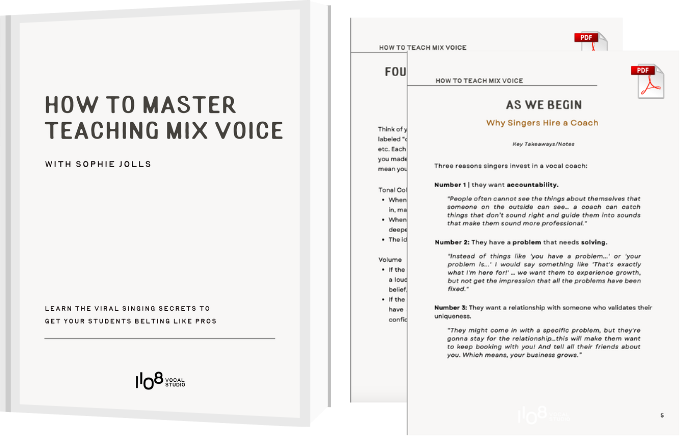
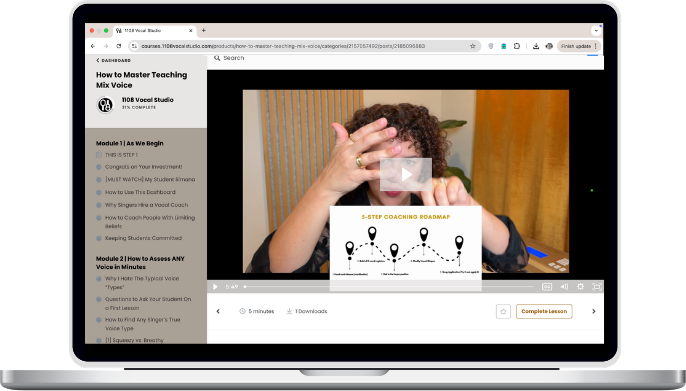
How to Master Teaching Mix Voice

Learn the Viral Singing Secrets to Get Your Students Belting Like Pros

In this course, we add The Mix Voice Method to your teaching toolbelt.

This method is designed to give you the right answers at the right time for your students.

I’m not just handing you a bunch of exercises and warm-ups (though when I do, they’re tailored to your student’s specific voice type)…

I’m showing you how to pinpoint exactly what your student needs and how to shape your lessons so they reach their goals faster.

Here’s what this will look like for you:

Module 1 – Get Total Clarity on Your Students' Needs

If you’ve ever felt like you’re jumping from one exercise to the next, unsure if your teaching is working, or wondering why nothing sticks, you’re not alone.

From day one, you join hundreds of other teachers using this method and step into a new role: the coach who has answers, confidence, and the right tools to help students go beyond quick fixes.

You finally see what’s really causing your students’ vocal problems, and you know exactly how to help them get past it.

You learn how to:

• Fix the real cause of vocal problems, not just cover up the symptoms (I’m looking at you, cracks, flips, and strain).

Use 3 simple belief shifts to help your students keep improving and avoid getting stuck.

• Get students to trust your teaching fully so they make faster progress and stop resisting.

    Module 2 – The "Never Get Stuck Again" Framework

    In this module, you learn how to understand the voice in front of you so you always know what to do next.

    Your lessons now flow naturally, weaving together technique, style, and the belief shifts your students need to grow.

    And instead of feeling stuck or unsure, you become the kind of teacher who knows exactly what to do in the moment, with tools that finally unlock the voice you’ve been trying to help.

    You learn how to:

    • Pinpoint whether a block is technical or mindset-related and adjust with precision.

    • Use a proven framework for building mix voice based on voice type.

    • Know why a student is straining, cracking, or losing power and what you need to do on the spot.

    • Shift students from chest to mix voice using the staircase for an effortless sound.

    • Create wins in every session that lead to breakthroughs, rebookings, and referrals.

    Module 3 – The Mix Voice Tools That Just Work (Like Really Work)

    This is where everything shifts.

    You’re using mix voice tools that actually work and not just sometimes, but with every voice type that walks through your door.

    You’re no longer hoping something clicks. It does click.

    You watch your students’ eyes light up when they hit that high note with power and it’s pure, clean, connected sound. 

    In module 3, you learn to:

    • Find a belt that fits your student’s body, goals, and vocal makeup without strain or guesswork.

    • Build a mix-belt by training the “staircase” and locking the technique into muscle memory.

    • Use all types of mix voice (chest mix, head mix, and everything in between) for stunning tone and smooth transitions.

    • Apply the number one exercise that develops vocal strength, resonance, and control (and keeps the cracks, flips, and strain away).

    • Build a full, flexible sound that supports belting, riffing, dynamics, and pitch so your students can sing soft, loud, or anywhere in between with total control.

    [BONUS] Module 4 – Advanced Fixes & Final Polish

    (The Voice Crack Crusher)

    You’ve already helped your students build a strong mix.

    But if you’re still asking, “What else can I do to help them improve?” (I love the over-deliverer energy!) 

    In Module 4, you learn why pitch problems happen and how to fix them with The Mix Voice Method.

    You finally fix the voice crack (the one that confuses so many teachers) by training the right muscles and helping students move sound the right way.

    You also learn my favorite exercise for fast, powerful breakthroughs: the inner edges.

    In this module, you:

      • Fix pitch issues and register cracks with proven mix voice techniques.

      • Utilize the most effective exercises for rapid vocal breakthroughs.

      • Train muscles and guide sound to transition smoothly between chest, mix, and head.

      • Help students move from tension or weakness to freedom and power.

      • Deliver lessons that create real progress and bring back joy and passion for teaching.

      FAQ's

      1. “This would help me and my students a ton, but I already feel stretched waaaay too thin. How do I find the time?”

      Let’s be real, vocal coaching isn’t the only thing on your plate.

      You’re probably juggling another job, a few gigs, maybe a toddler tugging at your leg, and don’t even get me started on emails and scheduling.

      So, the thought of adding one more thing?

      It can be a lot.

      That’s exactly why the lessons are short, easy to slip into your day, and focused on tools you can use in your teaching right away.

      And for hundreds of teachers, a shift happens in their very next lesson…

      From day 1, they know exactly what to do and where to go next, (bye-bye to the days where it took three lessons just to find out what will gain traction.)

      2. “My own mix isn't where I want it to be. How can I help students with something I'm still figuring out?”

      Great question.

      We all know demonstrating what to do is a big part of the job.

      But what if you’re not yet confident in your own mix? How do you show your students what to do?

      That’s actually one of the coolest things about the Mix Voice Method in How to Master Teaching Mix Voice:

      Everything you do to help your students… helps you too.

      As you teach, you’re also practicing and reinforcing your own mix voice live, in the moment.

      And I’ll show you exactly how to demonstrate what your students need so they get great results even as you’re still improving.

      3. “Is mix voice even a real thing?”

      Yep. But the industry has made a mess of this topic.

      There is a ton of info out there. Everyone uses different words, different methods, and different opinions. It gets confusing fast.

      And honestly, you don’t have time to sort through all the noise.

      You should have a simple and clear way to teach one of the most important aspects of singing– building mix voice.

      So here’s a shortcut: if my videos on social media have helped you, even just a 7-second tip—imagine what a whole course could do.

      4. “I sincerely love your way of describing things, and I've already noticed a shift just from your social media… but I just can't afford the course.”

      Totally valid.

      When you work at a company, they typically cover the cost of your training.

      But when you run your own studio, it’s all on you. And that can feel like a lot (especially when most trainings want you to fork over thousands — yikes).

      So here’s what happens when you use The Mix Voice Method to help your students:

      Your students can’t help but rebook session after session.

      Your students’ friends and family hear them and ask, “Wait. What are you doing? You sound amazing.”

      Soon, your biggest problem won’t be money; it’ll be figuring out how to raise your rates or fit in all the new students begging to work with you.

      In other words, the return on your investment doesn’t take months or years to show up. Just one re-book covers the cost, and what you’ll see happen is the value actually comes back tenfold.

      By now, you already know…

      If your students are cracking, flipping, straining, or losing power on high notes (and if you don’t want to take one of those $5,000 trainings that drag on for months while your wallet weeps), it all comes down to this:

      So, if you’re still reading, let’s get brutally honest for a sec…

      If you want to help even one student sing smoothly and powerfully from low to high… You need How to Master Teaching Mix Voice.

      If you can mix yourself but want to confidently coach any student—male, female, beginner, or pro… You need How to Master Teaching Mix Voice.

      If you’re classically trained, but your students want a more contemporary sound… You need How to Master Teaching Mix Voice.

      If you feel stuck, like you’re not helping your students the way you know you could… You need How to Master Teaching Mix Voice.

      If you want to stop wasting time in trial-and-error mode and start knowing exactly what to do… You need How to Master Teaching Mix Voice.

      If you're ready, I can't wait to help make this your most impactful and fulfilling year as a voice teacher.

      Because with How to Master Teaching Mix Voice, you now have the practical, step-by-step guidance to finally feel confident teaching one of the most misunderstood (and most in-demand) parts of vocal technique.

      But this isn’t something to sit on.

      Every lesson you teach without this clarity is another student left frustrated, confused, or even vocally at risk.

      Every week that goes by without this is another week you’re white-knuckling your way through lessons that could be game-changing—for you and your students.

      And if your students are still flipping, cracking, or losing power when they sing, something’s missing.

      Not in you—but in what the industry has handed you.

      That ends right now.